
Our Committment to Science
The Canadian Sablefish Association is making concrete investments in scientific research to protect the Sablefish resource and BC’s Sablefish fishery. To us, sustainable use requires research focused on a highly strategic management approach. This places the Canadian Sablefish Association among the world leaders in sustainable fisheries management. A few highlights of Canadian Sablefish Association’s commitment to research and sustainability include:
- Funding and conducting coastwide stock assessment and research surveys since 1991.
- Funding and conducting an ongoing tag release-recovery program (over 150,000 fish tagged) that provide information on Sablefish movement and gear selectivity for stock assessment.
- Leading stock assessments to characterize the status of Sablefish in BC.
- Leading a management strategy evaluation process since 2006 aimed at implementing robust procedures for setting annual catch limits consistent with sustainable use objectives.
- Funding research aimed at assessing interactions of longline trap gear with seafloor ecosystems.
- Funding ecosystem-based management research that recognizes the multi-gear, multi-species nature of BC’s integrated groundfish fishery.
- All our work on harvest advice is peer-reviewed by the Canadian Science Advisory Secretariat (CSAS).
- Our research on management strategy evaluation and gear interactions with fish habitat is published in peer-reviewed scientific journals.
We partner with Fisheries and Oceans Canada scientists and managers and private sector fisheries science experts to maintain a high standard of fisheries science and management advice.
Research and Stock Assessment Survey
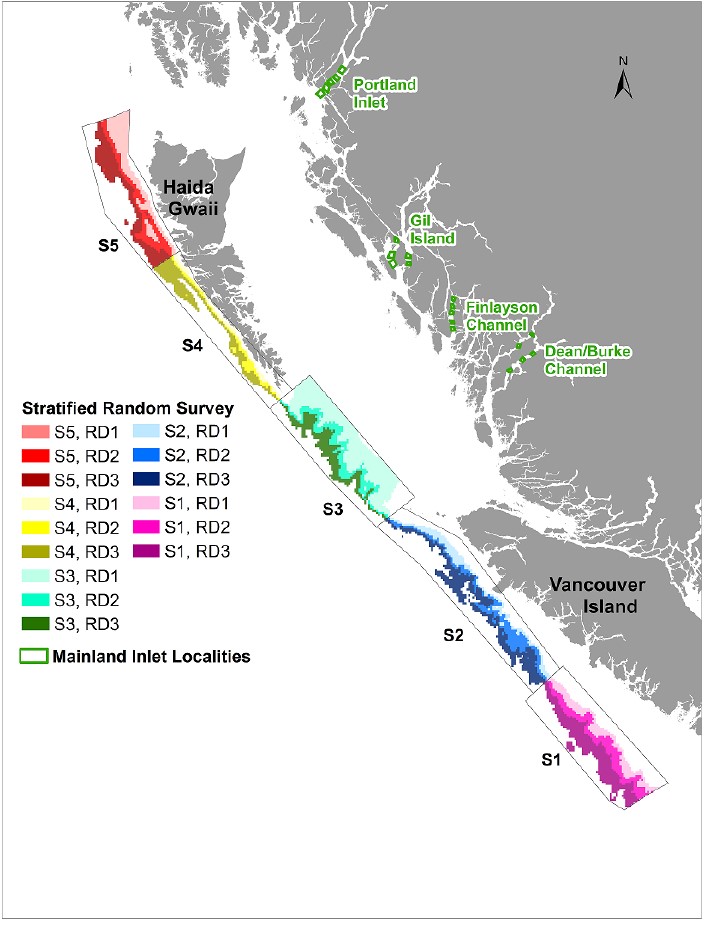
Annual surveys of BC Sablefish are conducted by commercial vessels chartered by the CSA. Working collaboratively with scientific technicians from Fisheries and Oceans Canada, we deploy standardized longline trap gear at over 100 locations in specified areas and depths along the entire BC outer coast every year. The surveys gather Sablefish stock abundance data and biological information such as fish size, sex, maturity and age. Sablefish are tagged for release and subsequent recapture in various commercial fisheries in Canada and the United States. Tag returns provide information on fish movement and fishing gear selectivity. Various scientific devices are deployed on survey sets including accelerometers for measuring gear movement, temperature-depth probes, and autonomous deep-sea cameras used to record video of the habitat encountered by the survey gear. The survey requires between 35 and 40 days to complete each October and November.
Sablefish surveys results are published as part of the Canadian Technical Report of Fisheries and Aquatic Sciences series:
Lacko, L.C., Acheson, S.M. and Holt, K.R. 2023. Summary of the annual 2021 Sablefish (Anoplopoma fimbria) trap survey, October 6 – November 21, 2021. Can. Tech. Rep. Fish. Aquat. Sci. 3530: vii + 48 p.
Management Strategy Evaluation
Our leading Sablefish Management Strategy Evaluation (MSE) process consists of:
- Setting or modifying fishery objectives in response to policy requirements, desired stock conditions, and socio-economic goals.
- Proposing different methods, called management procedures, for calculating an annual Sablefish catch limit.
- Testing the expected performance of the proposed management procedures over a range of uncertain present, and future, stock and fishery dynamics using computer simulation models, and
- Selecting one management procedure for annual application to the actual fishery.
The purpose of computer simulation testing is to check that applying the preferred management procedure will not lead to major problems, even if key scientific assumptions about the Sablefish resource (e.g., biomass, productivity) and fishery (e.g., gear selectivity, discard monitoring precision) are incorrect.
The Sablefish management procedure helps to establish a feedback link between current management actions and future stock responses. It does this by reducing fishing pressure to encourage population growth when Sablefish abundance declines and by allowing fishing opportunity when Sablefish abundance increases.
Fisheries Policy Compliance
Canada, like many other jurisdictions, advocates management by reference points in its precautionary approach fishery decision-making policy. Canada’s so-called “Fishery Decision-Making Framework Incorporating the Precautionary Approach” that three core requirements:
- Reference points and stock status zones (Healthy, Cautious and Critical).
- Harvest strategy and harvest decision rules.
- The need to take into account uncertainty and risk when developing reference points and developing and implementing decision rules.
The Sablefish management system incorporates a limit reference point (LRP) and target reference point (TRP) within specific fishery objectives that guide selection of management actions. An LRP can be a minimum level of spawning biomass that should not be breached, or a fishing mortality rate that should not be exceeded to avoid undesirable outcomes for the stock and fishery. Target reference points indicate desirable states expected to provide ecosystem, economic, and socio-cultural economic benefits. For Sablefish, requirement (1) of the PA Policy is met by characterizing stock status relative to fractions of the spawning biomass at maximum sustainable yield, BMSY.
The Sablefish management procedure is synonymous with a harvest decision rule. The selection of management procedure is guided by how closely a set of conservation and yield objectives is satisfied, and therefore meets requirement (2) of the PA Policy.
Finally, testing of management procedure performance under a variety of simulated stock and fishery conditions means that uncertainty is considered before a particular choice of management procedure is applied to the actual fishery. This process eliminates management options that are unlikely to work in practice, thereby closing the gap between precautionary fisheries management in theory, and precautionary management in practice.
Sablefish Stock Status
Stock status for BC Sablefish is characterized relative to fishery reference points related to the spawning biomass at maximum sustainable yield, or BMSY. We also evaluate the harvest rate relative to the harvest rate at maximum sustainable yield, or UMSY. Stock status was last evaluated in 2022 and reviewed by the Canadian Science Advisory Secretariat. In summary, there is a high probability that BC Sablefish was above the target biomass of BMSY in 2022 (about 1.3 times BMSY) and that the harvest rate in 2021 was below UMSY (about 70% of UMSY). DFO has reported that the abundance of BC Sablefish is in the “Healthy Zone” using the criteria in Canada’s precautionary approach harvest policy.
From seafloor observation to spatial decisions
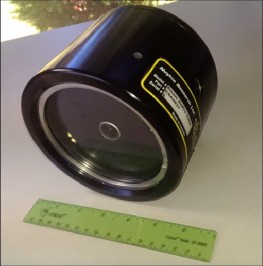
Sablefish harvesters understand that habitat forming species like corals and sponge are necessary for functioning marine ecosystems and sustainable fisheries. That’s why the CSA supports research to identify and improve management measures to reduce fishery impacts on fish habitat. In 2010 the CSA, through Wild Canadian Sablefish Ltd., joined with Simon Fraser University researchers and Fisheries and Oceans Canada (DFO Pacific Region) to design, build, and deploy an autonomous video camera and motion-sensing system capable of operating at extreme depths of 200–1800 m where Sablefish occur. The camera system, along with accelerometers and depth sensors, have been deployed annually on selected commercial fishing trips and on the annual stratified random, fishery-independent Sablefish trap-gear survey that is jointly funded by WCS and DFO.
Beginning in 2023 we extended our research using data from our novel deep-sea autonomous cameras to quantify gear–habitat interaction, develop habitat risk metrics, and embed them in a spatial Management Strategy Evaluation framework to support explicit evaluation of trade-offs. This work was supported by a contribution agreement funded jointly by DFO, the Government of British Columbia, and Wild Canadian Sablefish Ltd. via the British Columbia Salmon Restoration and Innovation Fund.
From Observation to Decision Support
Spatial management of fishery interactions with marine habitat is not simply a mapping exercise. It is a decision problem requiring evidence that links fishing activity to habitat outcomes and tools that make trade-offs explicit. The Canadian Sablefish Association research program has developed the following five-step decision-making framework:
Together, these steps move habitat science from descriptive mapping to quantitative decision support.
Seeing the Seafloor
Integrated Habitat Observation: Autonomous cameras and motion sensors mounted on commercial longline trap gear collected in situ observations of corals and sponges while simultaneously recording gear movement and bottom contact.
This approach:
- Generates structured presence–absence data for sensitive benthic habitats
- Records when and where bottom contact occurs
- Avoids the bias associated with presence-only data
The result is a fishery-integrated dataset linking habitat occurrence directly to fishing operations.
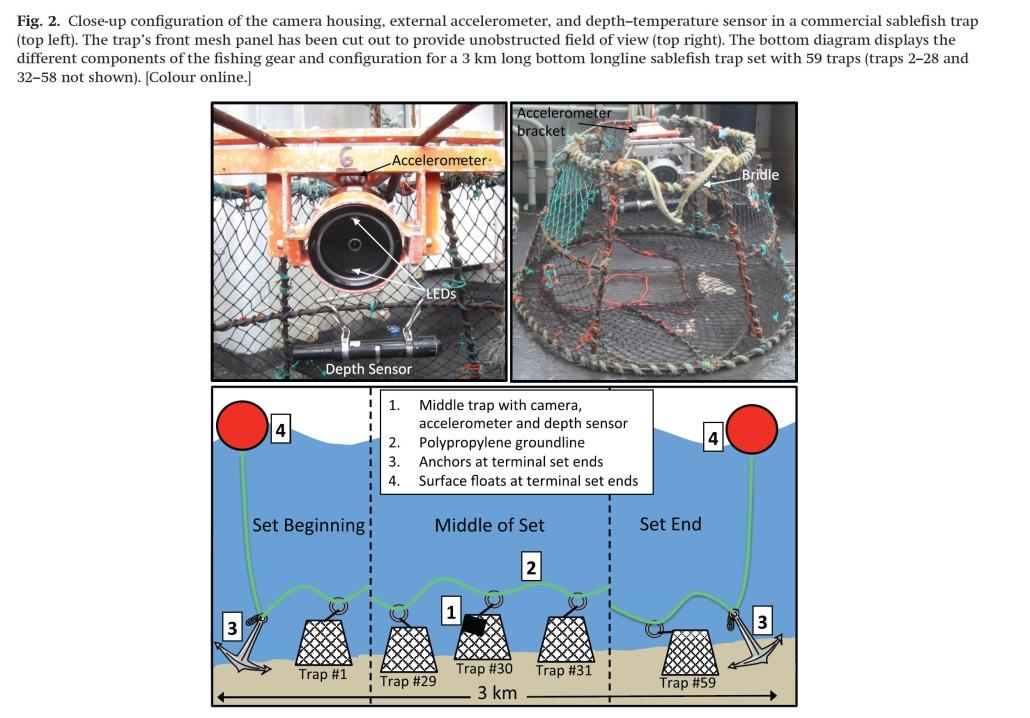
source: https://cdnsciencepub.com/doi/10.1139/cjfas-2016-0483
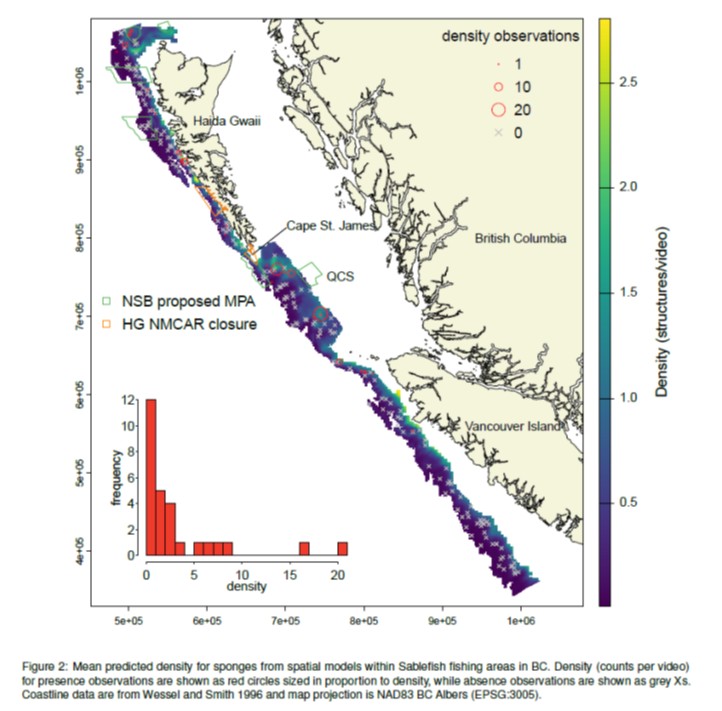
Video from the cameras is interpreted to identify the presence and absence of habitat forming species such as cold-water corals (Alcyonacea, Antipatharia, Pennatulacea, Stylasteridae) and sponges (Hexactinellida, Demospongiae). The resulting data are used to build species distribution models which aim to predict the location of corals and sponges and improve information for fisheries management and marine-use planning.
From Observation to Fishing Footprint
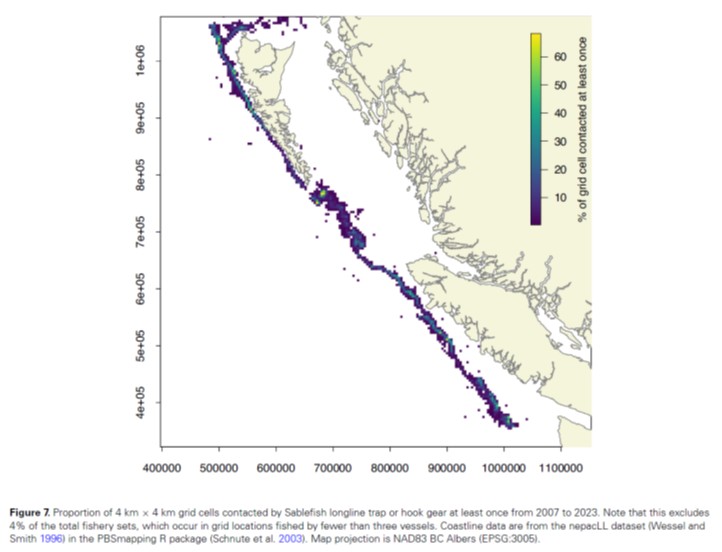
Estimating Fishing Footprints: Using video, accelerometers, depth sensors, and commercial effort records, spatially explicit estimates of bottom contact were developed for longline trap and hook gear.
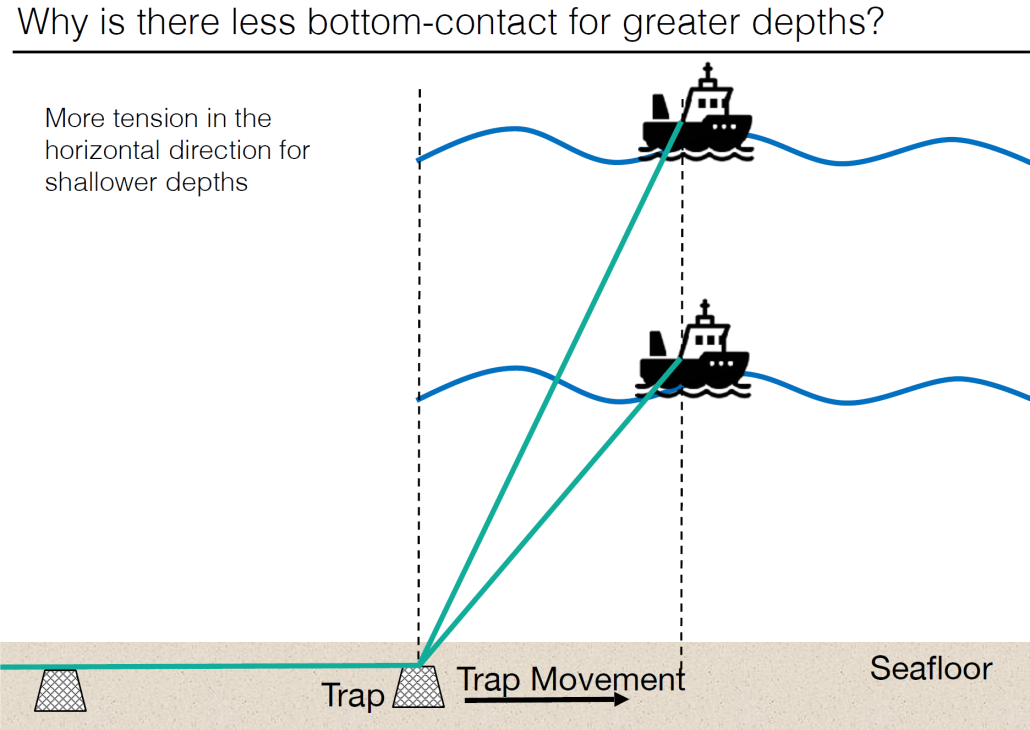
Unlike approaches that assume uniform or maximal impact, contact was estimated using gear-specific movement models that account for:
- Trap geometry
- Retrieval behaviour
- Fishing depth
- Historical effort distribution
Results indicate that most of the historical Sablefish fishing grounds experienced no contact with sensitive benthic habitats, and areas that were contacted were typically contacted infrequently.
This work provides quantitative estimates of habitat–contact area at fine spatial scales.
Scientific References
Mapping Sensitive Habitats
Presence–Absence Species Distribution Modelling: Video observations were integrated with environmental covariates and spatial structure to develop species distribution models for corals and sponges. The purpose of this step is to:
- Produce spatially continuous predictions of habitat occurrence
- Account for imperfect detection and sampling uncertainty
- Generate predictive habitat maps at management-relevant scales
This step converts discrete observations into spatial habitat layers suitable for overlap and risk analysis.
Estimating Habitat Risk and Status
From Overlap to Ecological Condition: Habitat predictions and fishing footprints were integrated within spatial population models to estimate cumulative habitat condition relative to unfished states.
This risk assessment framework:
- Accounts for disturbance and recovery
- Produces quantitative habitat status metrics
- Generates time-varying spatial estimates of relative benthic status
Rather than focusing solely on overlap between fishing and habitat, the analysis estimates ecological condition through time.
Testing Future Management
Embedding Habitat Risk in Simulation: The final step integrates quantitative habitat status metrics within a spatially explicit Management Strategy Evaluation framework.
Simulation experiments evaluate:
- Alternative closure designs
- Redistribution of fishing effort
- Habitat recovery trajectories
- Trade-offs between conservation outcomes and fishing opportunity
- The value of improved habitat information
By testing management strategies in simulation before implementation, the framework supports transparent evaluation of how spatial measures allocate risk and access across space.
Interactive Spatial Visualization
The interactive spatial visualization app is designed to communicate components of the five-step habitat risk framework.
The tool allows users to explore selected analytical layers, including:
- Direct seafloor observations from deep-water camera deployments
- The spatial footprint of the longline fisheries
- Predicted density of corals and sponges
- Modelled probability of habitat presence derived from species distribution models
By toggling among layers, users can see how observed habitats, predicted distributions, and fishing footprint patterns align across space. The application is intended to visually connect these components and illustrate how they are integrated within the broader habitat risk assessment process.
This interface is a visualization tool and does not provide access to underlying raw datasets. Its purpose is to present the spatial structure of the analysis in a clear and accessible format.
What This Research Enables
In many cases, spatial closures are implemented under conditions of uncertainty, with precautionary reasoning used to justify restricting fishing activity in areas where habitat risks are perceived to be high. While precaution is an essential component of responsible management, it can be misapplied when it substitutes for quantitative evaluation of risks and benefits. Poorly targeted closures may result in unnecessary loss of access to fishing grounds, displacement of fishing effort, and unintended redistribution of both ecological and economic risk. These outcomes highlight the need for analytical frameworks that make trade-offs explicit, rather than relying on precaution alone as a decision rule. This completed research program provides:
- Quantitative estimates of fishing footprints
- Predictive habitat maps grounded in fishery-integrated data
- Explicit measures of habitat condition
- A simulation-based framework for evaluating trade-offs between habitat protection and fishery access.
Together, these components support spatial management decisions that are evidence-based, transparent, and adaptable. Rather than relying solely on precaution, management strategies can be evaluated using quantitative metrics that compare conservation performance and fishery outcomes under uncertainty.
Future Development
Building on this completed framework, ongoing work focuses on scalable monitoring systems that allow industry-led collection of habitat and gear-interaction data as part of routine operations. Standardized, next-generation camera platforms will support long-term monitoring and continuous improvement of spatial decision support tools.
Download the Canadian Sablefish Association infographic on seafloor monitoring

Scientific References
Scientific References (expand to view list)
Scientific References
Published work on the BC Sablefish Management Strategy Evaluation, stock status, and interaction of longline fishing gear with seafloor habitat can be found here:
CSAS Science Advisory Reports and Science Responses
DFO. 2026. An investigation of ageing requirements to support the British Columbia Sablefish (Anoplopoma fimbria) operating model. DFO Can. Sci. Advis. Sec. Sci. Resp. 2025/013. https://waves-vagues.dfo-mpo.gc.ca/library-bibliotheque/41316149.pdf
DFO. 2025. Application of the British Columbia Sablefish (Anoplopoma fimbria) management procedure for the 2025-26 fishing year. DFO Can. Sci. Advis. Sec. Sci. Resp. 2025/018. https://waves-vagues.dfo-mpo.gc.ca/library-bibliotheque/41293903.pdf
DFO. 2024. Application of the British Columbia Sablefish (Anoplopoma fimbria) management procedure for the 2024-25 fishing year. DFO Can. Sci. Advis. Sec. Sci. Resp. 2024/013. https://waves-vagues.dfo-mpo.gc.ca/library-bibliotheque/41244072.pdf
DFO. 2023. Application of the British Columbia Sablefish (Anoplopoma fimbria) management procedure for the 2023-24 fishing year. DFO Can. Sci. Advis. Sec. Sci. Resp. 2023/009. https://www.dfo-mpo.gc.ca/csas-sccs/Publications/ScR-RS/2023/2023_009-eng.html
DFO. 2023. A revised operating model for Sablefish in British Columbia in 2022. DFO Can. Sci. Advis. Sec. Sci. Advis. Rep. 2023/010. https://www.dfo-mpo.gc.ca/csas-sccs/Publications/SAR-AS/2023/2023_010-eng.html
DFO. 2020. Evaluating the robustness of candidate management procedures in the BC Sablefish (Anoplopoma fimbria) fishery for 2019-2020. DFO Can. Sci. Advis. Sec. Sci. Resp. 2020/025. https://www.dfo-mpo.gc.ca/csas-sccs/Publications/ScR-RS/2020/2020_025-eng.html
DFO. 2017. Evaluating the robustness of management procedures for the Sablefish (Anoplopoma fimbria) fishery in British Columbia, Canada for 2017-18. DFO Can. Sci. Advis. Sec. Sci. Advis. Rep. 2017/017. https://www.dfo-mpo.gc.ca/csas-sccs/Publications/SAR-AS/2017/2017_017-eng.html
DFO. 2016. A revised operating model for Sablefish (Anoplopoma fimbria) in British Columbia, Canada. DFO Can. Sci. Advis. Sec. Sci. Advis. Rep. 2016/015. https://www.dfo-mpo.gc.ca/csas-sccs/Publications/SAR-AS/2016/2016_015-eng.html
Primary Literature
Cox, S.P., Kronlund, A.R., and Benson, A.J. 2013. The roles of biological reference points and operational control points in management procedures for the Sablefish (Anoplopoma fimbria) fishery in British Columbia, Canada. Environmental Conservation 40: 318–328. doi: https://doi.org/10.1017/S0376892913000271
Cox, S.P., and Kronlund, A.R. 2008. Practical stakeholder-driven harvest policies for groundfish fisheries in British Columbia, Canada. Fisheries Research 94: 224–237. doi: https://doi.org/10.1016/j.fishres.2008.05.006
CSAS Research Documents
Johnson, S.D.N., Cox, S.P., Holt, K.R., Lacko, L.C., Kronlund, A.R. and Rooper, C.N. 2025. Stock status and management procedure performance for the BC Sablefish (Anoplopoma fimbria) fishery for 2022/23. DFO Can. Sci. Advis. Sec. Res. Doc. 2024/072. iv + 137 p. https://waves-vagues.dfo-mpo.gc.ca/library-bibliotheque/41279281.pdf
Cox, S.P., Kronlund, A.R., Lacko, L., and Jones, M. 2023. A revised operating model for Sablefish in British Columbia, Canada in 2016. DFO Can. Sci. Advis. Sec. Res. Doc. 2023/023. vii + 127 p. https://www.dfo-mpo.gc.ca/csas-sccs/Publications/ResDocs-DocRech/2023/2023_023-eng.html
Cox, S., Holt, K., Johnson, S. 2019. Evaluating the robustness of management procedures for the Sablefish (Anoplopoma fimbria) fishery in British Columbia, Canada for 2017-18. DFO Can. Sci. Advis. Sec. Res. Doc. 2019/032. vi + 79 p. https://www.dfo-mpo.gc.ca/csas-sccs/Publications/ResDocs-DocRech/2019/2019_032-eng.html
Gear Interactions with Habitat
Doherty, B., Lacko, L., Kronlund, A.R., Alexander, K, and Cox, S.P. 2025. Quantitative estimates of contact with seafloor habitats by longline trap and hook fishing gear. ICES J. Mar. Sci., 82(3), 2025. doi: https://doi.org/10.1093/icesjms/fsaf026
Doherty, B. Cox, S.P., Rooper, C.N., and Kronlund, A.R. 2021. Species distribution models for deep-water coral habitats that account for spatial uncertainty in trap-camera fishery data. Marine Ecology Progress Series. 660. doi: http://dx.doi.org/10.3354/meps13564
Doherty, B., Johnson, S.D.N. and Cox, S.P. 2018. Using autonomous video to estimate the bottom-contact area of longline trap gear and presence–absence of sensitive benthic habitat. Can. J. Fish. Aquat. Sci.75:797–812. doi: https://doi.org/10.1139/cjfas-2016-0483
Doherty, B., and Cox, S. 2017. Data summary of trap camera video obtained during Sablefish bottom longline trap fishing at SGaan Kinghlas – Bowie Seamount, 2014–2015. Can. Dat. Rep. Fish. Aquat. Sci. 1276. Fisheries and Oceans Canada. https://publications.gc.ca/collections/collection_2017/mpo-dfo/Fs97-13-1276-eng.pdf

